Getting Charge Out of a Winter Sun
The panel is fine — cold actually suits it. What changes is the sun: lower in the sky, for fewer hours. A setup that cruised through summer can be giving you a quarter of that in midwinter with nothing wrong anywhere, and winter is the season where getting it right pays most.
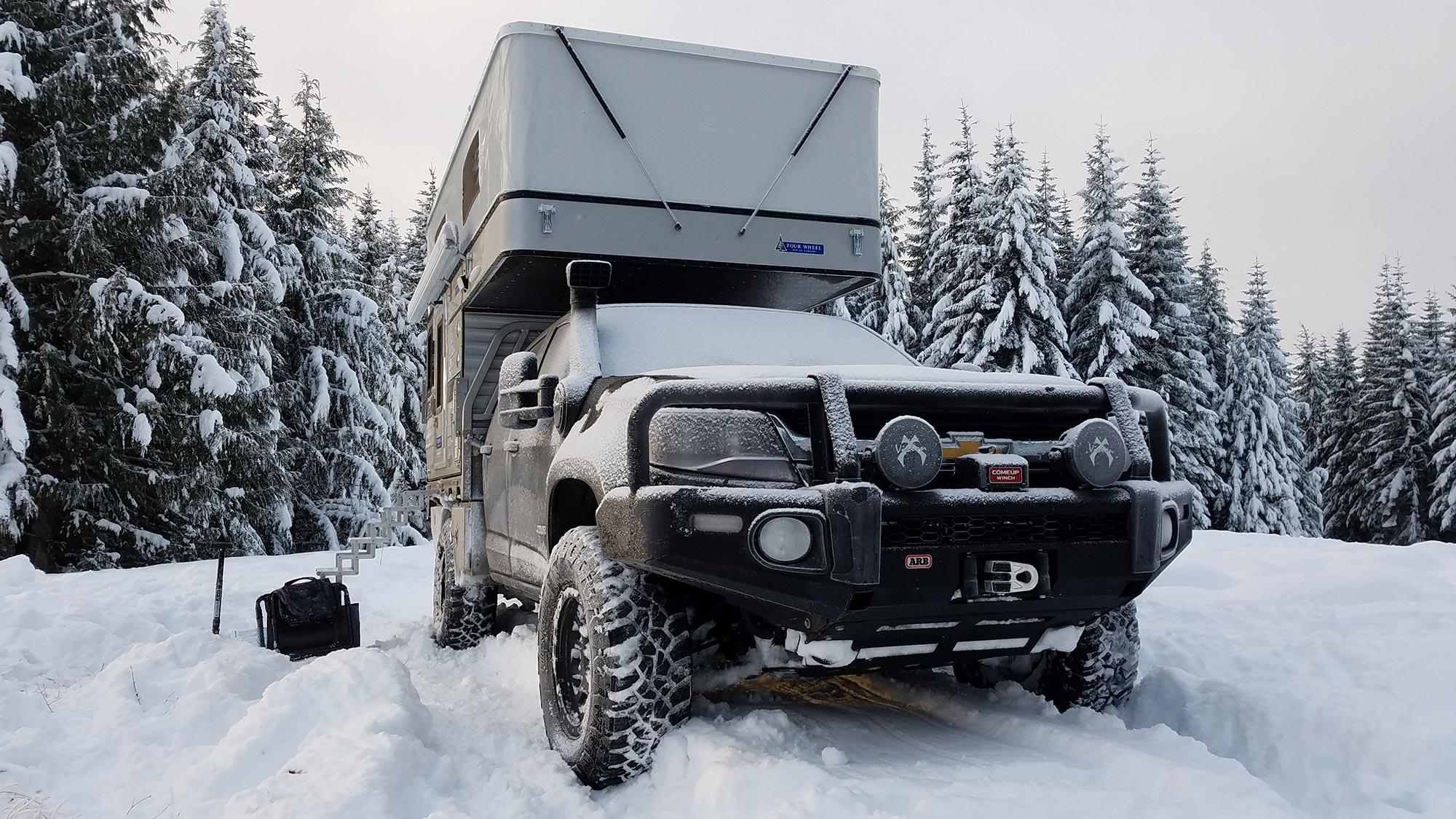
The panel is fine. The sun isn't.
Cold suits a panel. They lose output as they heat up, so a clear winter's day runs the cells near their rated temperature with none of the summer heat penalty — watt for watt of light landing on it, your panel is more efficient in winter than in summer.
What changes is how much light lands on it. Two things, and they multiply rather than add.
The day is shorter — eight hours of usable light instead of fourteen, depending how far you are from the equator. Nothing you can do about that one.
The sun sits lower, and that costs more than it looks. Light arriving at a shallow angle spreads the same energy over a bigger area, so a flat panel collects a fraction of what it would square-on:
| Sun's height above the horizon | What a flat panel collects |
|---|---|
| 15° — low winter sun | 26% |
| 20° | 34% |
| 30° | 50% |
| 45° | 71% |
| 60° — high summer sun | 87% |
That's trigonometry, and it holds at any latitude. It's also the whole argument for standing a panel up: the flatter your panel, the harder a low sun punishes it. Flat under a 20° sun throws away two thirds before cloud, dust or anything else gets a look in. Stand it up square to the sun and that loss comes back for as long as it's facing the sun.
Across a whole winter's day the gain is smaller than that table suggests, because the hours around noon were never as bad and some light comes from the whole sky rather than from the sun. It's still big, and it grows the further you are from the equator. Here's a flat panel against one stood up at latitude plus 15°, using long-term averages for each place's midwinter month:
| Midwinter, per m² of panel | Flat | Stood up | Gain |
|---|---|---|---|
| Brisbane, 27°S — June | 3.0 kWh | 4.3 kWh | ×1.4 |
| Sydney, 34°S — June | 2.4 kWh | 3.8 kWh | ×1.6 |
| Melbourne, 38°S — June | 2.0 kWh | 3.3 kWh | ×1.7 |
| Denver, 40°N — December | 2.4 kWh | 4.5 kWh | ×1.9 |
| Hobart, 43°S — June | 1.5 kWh | 2.8 kWh | ×1.9 |
| London, 52°N — December | 0.7 kWh | 1.7 kWh | ×2.5 |
In summer it runs the other way. The sun is already high, a flat panel is close to ideal, and a panel stood up that steeply would lose charge. That's why the gap between a lazy setup and a good one is far wider in winter than in summer.
What to change when the sun drops
- Steepen it, more than feels right. The direction doesn't change — the sun just sits lower, so the tilt goes steeper. Latitude plus about 15°: at 50° that's a panel standing near 65°, which looks wrong and isn't. Going a few degrees steeper still costs almost nothing in midwinter. The angle that faces the noon sun swings about 47° across the year.
- Watch the shadows. A low sun throws them several times the height of whatever casts them, so the vehicle, the wall and the awning all reach your panel now. Shade costs far more than its size suggests — here's why.
- Be set up before the good hours, not during them. Winter light is squeezed into a few hours either side of noon. The first and last hour, with the sun barely off the horizon, are worth almost nothing.
- Reposition at least once. The sun still crosses 15° of sky an hour. It just does it lower down.
- Clear snow off completely. A full covering takes a panel to almost nothing and even a thin layer cuts it hard. A half-cleared panel leaves you with the shade problem instead. A steep tilt helps it slide off.
The cold does catch the battery, though. Most lithium batteries refuse charge below about 0 °C. They don't slow it down, they refuse it, because charging a frozen cell damages it for good. A frosty morning can be full sun and no charge until the battery warms up. Some batteries have a built-in heater for exactly this. If yours has neither a heater nor a low-temperature cutoff, don't charge it below freezing (more on the cold cutoff).
Cold also pushes panel voltage up, highest at first light on a frosty morning. If your panels are wired in series, leave 15–20% headroom under the controller's input limit (here's how).
The squeeze comes from both ends
Charge drops and draw rises together. Longer nights mean more hours of lights, and of a heater if you run one, and more of the fridge's running done on the battery alone with no solar offsetting it. A setup that comfortably broke even in summer can run down a few percent a day in midwinter with no obvious culprit, and you find out three days in. What a night actually costs you is the other half of it.
Where the app does the hard part
Everything above turns on one number you can't see: how high the sun will get today, and where it will track. That changes with your latitude and the date, so it moves every time you drive somewhere or another fortnight passes — a panel set right in Madrid is set wrong in Edinburgh the same afternoon. There's no rule of thumb that survives it, and pacing out shadows at 8am doesn't either.
Solar Spotter works it out for exactly where you're standing and tells you the two things you actually need: what angle to set, and which hours are worth being set up for. On a short winter day that's the whole game, and it takes a glance rather than a calculation.
- Season comes from your position, not the month — right at any latitude, either hemisphere.
- It gives you the angle, and it will read steeper than the rule. Opt. Tilt, on the Solar Position card, is the angle that faces the sun square-on right now. In winter that's steep, and steeper still early and late in the day. Latitude plus 15° is the set-and-forget number, while Opt. Tilt is the number for this moment. The compass has a tilt in its middle too, live for whichever way the phone points. Face it along one of the compass bands and that number turns the band's colour and becomes one angle for that whole period, weighted toward the hours that actually charge.
- It shows the honest ceiling. The Solar Conditions card has two numbers, and winter is when they part ways. Sky Rating is how much light the sky is letting through. W/m² is how much is actually arriving. On a cloudless midwinter noon Sky Rating can read 100% while W/m² sits well below what a summer noon delivers. That isn't a fault. It's the low sun. The same number is graded: 500 W/m² and up is Excellent, 300–500 Good, 150–300 Moderate, and under 150 Poor. A perfect midwinter noon comes out around Good in Sydney, Moderate in Hobart and Poor in London.
- It tells you early. In the free app, the Solar Day card grades the rest of today the same way, from now to sunset, with how much sun is left. Knowing at nine that today won't charge much is what lets you ease off the big loads and plan around it, instead of finding out at dusk. Under 15° of sun, Shade Risk adds Low sun angle, and in midwinter at high latitudes that can be most of the day.
- Free gives you the sun's bearing now, plus two bands on the compass tracing the part of the sky the sun crosses over the next three hours and the next six, with a bearing for each under the dial. On a short winter day the six-hour band often runs out at sunset, and it stops there. Pro adds the Best Charging Window, the hours of today the forecast says are worth charging in, rolling forward as the day goes. It also adds Planned Charge in the menu (Duration, Window or BCW), which turns Opt. Tilt into one angle for the whole time you'll be set up and draws that period on the compass. That's the difference between knowing today's ceiling and being positioned for it.
- The sun maths works with no signal, which is generally where you are: a winter camp, a week's boondocking, a long overlanding leg with the days at their shortest. The compass, the tilt and the sun times all run on your phone. The sky readings need a connection, and Bush Bash Mode in the menu keeps the last forecast on screen with the time it was fetched. There's no account and no tracking. The only time your location leaves the phone is the weather request, so the forecast is for where you are, and nothing is stored. One-off purchase.
Common questions
Do solar panels work in winter?
Yes, and the panel itself works better than it does in summer because it stays cool. What drops is the sunlight available: the day is shorter and the sun sits much lower, so less energy lands on the panel. A well-positioned panel in winter can still do real work — a flat one usually can't, because a low sun treats a flat panel very harshly.
What angle should a solar panel be in winter?
Roughly your latitude plus 15°, stood up to face the equator. At 40° that's about 55°; at 50° it's about 65°, which is nearly upright and looks wrong until you see the charge. The steeper angle is there to meet a sun that never gets high, and it has the side benefit of shedding snow.
How much less solar do you get in winter?
It depends entirely on your latitude, and the spread is huge — near the equator winter barely registers, while at 55° or 60° a midwinter day can give you a small fraction of a midsummer one. Fewer daylight hours and a lower sun stack together. On a flat panel, long-term averages put Sydney's June at under 40% of its December, Hobart's June under a quarter of its January, and London's December at about an eighth of its June. No single percentage holds, so calculate for where you actually are rather than reading a national figure.
Does snow damage solar panels?
No — panels are built for it and a covering of snow won't hurt them. It will stop them working, though. A full covering takes a panel to almost nothing, and even a thin layer cuts it hard. Clear it off fully rather than partially: a half-cleared panel leaves you with a shading problem, which can cost nearly as much as the snow did. A steep winter tilt helps snow slide off on its own.
Is it worth using solar at all in midwinter?
At most latitudes, yes — but the setup has to be right, because winter punishes a lazy one far harder than summer does. Standing the panel up properly and keeping it out of the long shadows can be the difference between a trickle and something that genuinely offsets your fridge. Very far north or south, midwinter can put you into a period where solar simply can't be the main answer, and that's worth planning for rather than discovering.
Get the most out of a short day
Solar Spotter works out the sun's height and track for your latitude and today's date, the angle to set, and how good the rest of the day will be. Free to download.