How to Set Up Your Solar for Maximum Charge
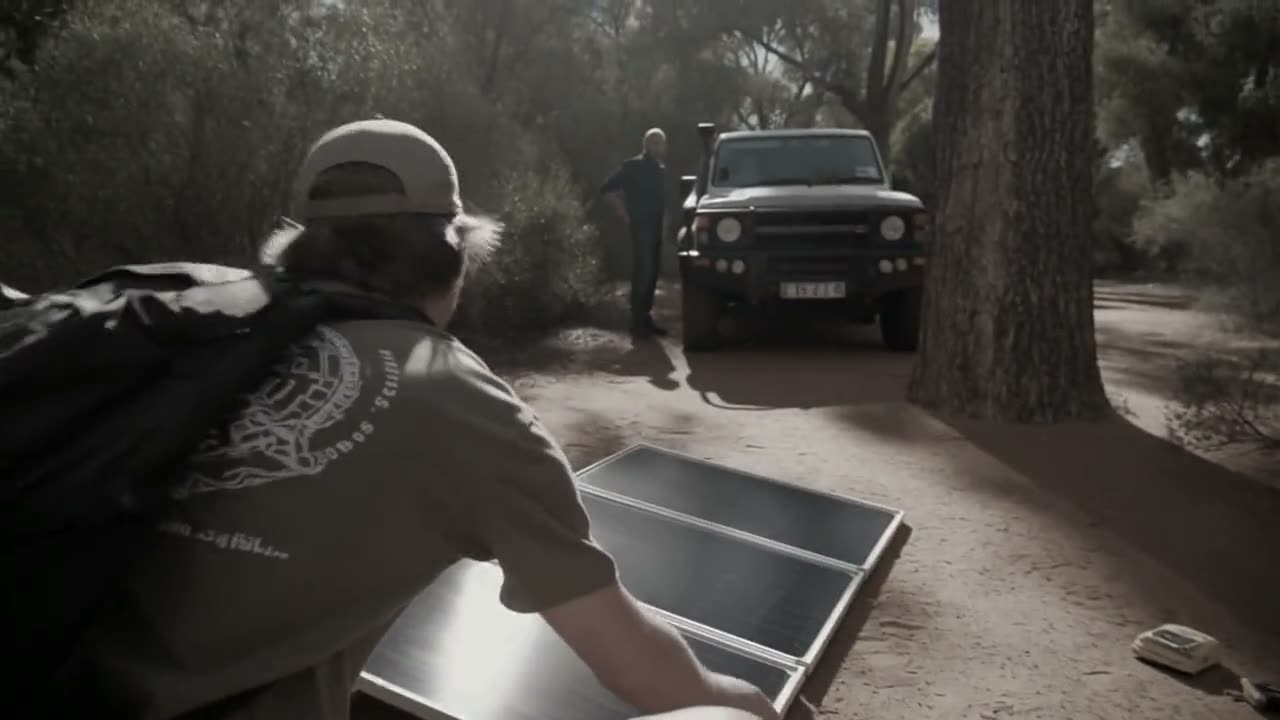
Two campers, same panel, same sunny day — one's topped up by lunch, the other's still half-empty at dark. It's almost never the gear. It's where the panel sits, which way it faces, and how it's angled. Here's how to get the most out of what you've already got.
How much does setup actually matter?
On a clear winter's day at mid latitudes, a panel lying flat on the ground pulls in about half of what the same panel makes set up properly. A rough guess — too flat and turned well off the equator — can cost you about a third. Same panel, same sun, same day — the only difference is five minutes of setup.
And you can fix it with the gear you already own.
Start with the angle — your biggest lever
Two things set it:
- Tilt — how far the panel stands up from flat.
- Direction — which way the face points.
Nothing else you can do at camp moves the number as much.
Why eyeballing feels like it works
Set a panel up by eye, nudge it 15° off, and you genuinely won't see much in it — about 3% gone. Which is exactly why eyeballing feels fine.
It stays true for about an hour.
The sun travels 15° an hour. So the panel you set spot-on at nine is 15° out by ten, 30° out by eleven, and 45° out by noon. You didn't get it wrong — it went wrong on its own, while you were making a cuppa and having a bite to eat.
What that costs across a day
A clear winter day at around 35° latitude — Los Angeles, Tokyo, Sydney — measured against a panel set the way this guide recommends:
| How it's set up | What the day gives you |
|---|---|
| Lying flat on the ground | 48% |
| Guessed — off-equator, too flat | 67% |
| Tilt set to your latitude, unadjusted | 91% |
| Latitude +15° for winter — the rule below | 100% |
| Positioned for a three-hour window — early morning or late arvo, compared with the rule-set panel over those same hours | 121% |
Guessing costs about a third of your winter day. Leaving it flat costs about half. Neither is a rounding error.
But it's the last row that matters.
A panel set correctly for the whole day is set wrong for every hour of it. It's a balance struck across morning and afternoon — which is exactly what you want if you're set up and away all day. Position it for the three hours you actually need instead — the morning push before you break camp, the arvo top-up when you're back — and it pulls in about a fifth more than the best all-day angle can. Against a guessed setup in those same hours, it's more than half again.
That's the whole game, and it's why there's no angle worth memorising. The charging window is the thing to set up for — not the day, and definitely not the moment.
Direction: face the equator
Face the panel toward the equator — south across the US, the UK and Europe; north across Australia, New Zealand and southern Africa. That's where the sun sits through the middle of the day, so you catch its longest run. (In the tropics around midsummer the sun can sit on the other side of you — the app follows the sun, not the rule.)
One catch worth knowing: that's true south, not the south your compass needle points to. Depending where you are, the two can sit more than 15° apart — enough to cost you real charge on its own.
Tilt: your latitude, then lean into the season
The working rule: set the tilt to roughly your latitude, then add about 15° through winter and take about 15° off through summer. It works best between about 25° and 45° latitude. Further from the equator, go much flatter in summer — close to flat in midsummer. In the tropics, let the app pick the direction.
| Roughly where you are | Baseline tilt | Winter / summer |
|---|---|---|
| Miami · Cairo · Brisbane (~26–30°) | ~28° | 43° / 13° |
| Los Angeles · Tokyo · Sydney (~34–36°) | ~35° | 50° / 20° |
| New York · Madrid · Chicago (~40–42°) | ~41° | 56° / 26° |
| London · Berlin · Vancouver (~49–52°) | ~51° | 66° / 36° |
The further from the equator you are, the more the season swings it — which is why a fixed angle that suits a London summer is badly wrong by December.
The seasons move it too
The Earth leans about 23.5° on its axis. That's why the midday sun rides high overhead in summer and sits low across the sky in winter — and why the angle that faces the noon sun square-on swings about 47° across the year. The best angle for the whole day swings even more — about 55–60° at mid and high latitudes.
Shade beats angle, every time
Get everything above right and a shadow will still undo it. Panels are wired in series, and a series runs at the speed of its weakest link — so a shadow falling across a few cells throttles the whole panel, not just the bit it covers. A branch shadow over a fraction of the surface can cost you far more than that fraction.
How much more depends on the panel — how it's wired, whether it has bypass diodes to isolate the shaded section. There's no single number that's true of every panel, and anyone quoting you one is guessing. What holds everywhere: shade costs more than it looks like it should, so treat it as the first thing to solve, not the last.
Park the panel where nothing crosses it for your whole charging window — not just where it's clear right now. That tree's shadow will swing round as the day goes on, and it moves faster than you'd think.
Portable or fixed — different jobs
- Blanket or folding panel. The flexible one: you can stand it up, position it properly, and move it through the day. It rewards a good setup most, and punishes a lazy one hardest — standing it up and positioning it can make anywhere from a little more (a summer midday) to two or three times as much (a winter morning) as leaving it flat. Getting the most from a blanket has its own knack.
- Fixed or roof-mounted. Set once, then forget. You trade the best angle for never having to think about it, so it leans on being parked in open sun and catching the long middle of the day.
Neither's wrong. But if yours moves and you're leaving it flat, you've bought the flexible option and are using it like the fixed one.
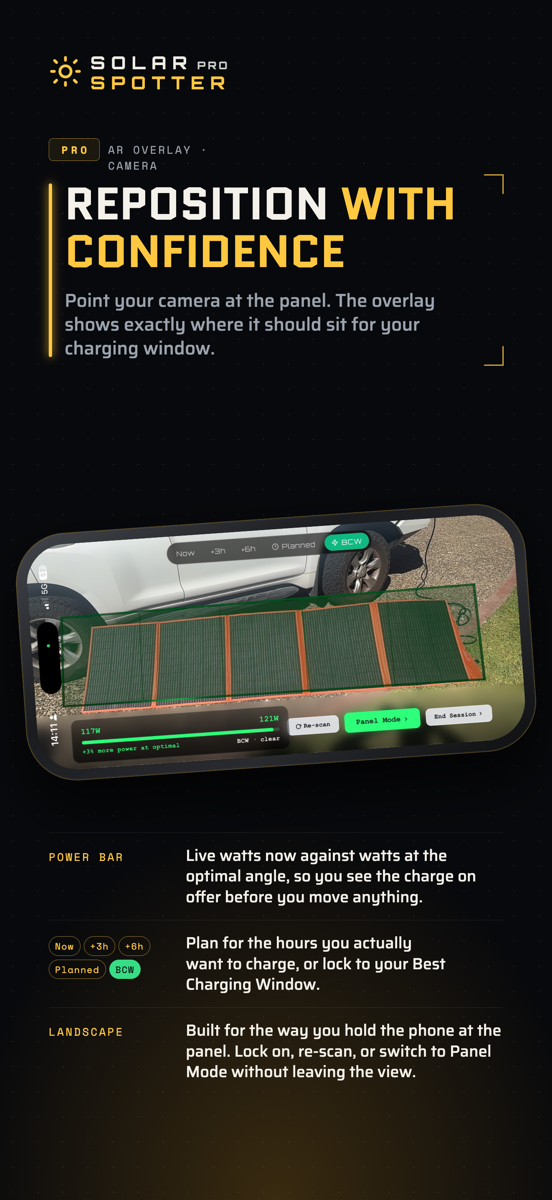
117 W now, 121 W once it's aligned.
The bit that actually wins: your charging window
Here's what no rule of thumb can know. You rarely need charge "on average, across the day". You need it in a window — a hard push of sun before you break camp, an arvo top-up once you're back from the track, every last watt before a ridge swallows the sun at three o'clock.
And as the table showed, the angle that wins a three-hour window isn't the angle that wins the day. For an early or late window it's worth about a fifth more than even a well-set panel — and better than half again over a guessed one.
Working that out by hand means knowing where the sun will be for those specific hours, at your exact spot, on today's date, and what the sky's going to do. That's the bit that isn't eyeballable — not because you're not clever, but because it's arithmetic about a moving target.
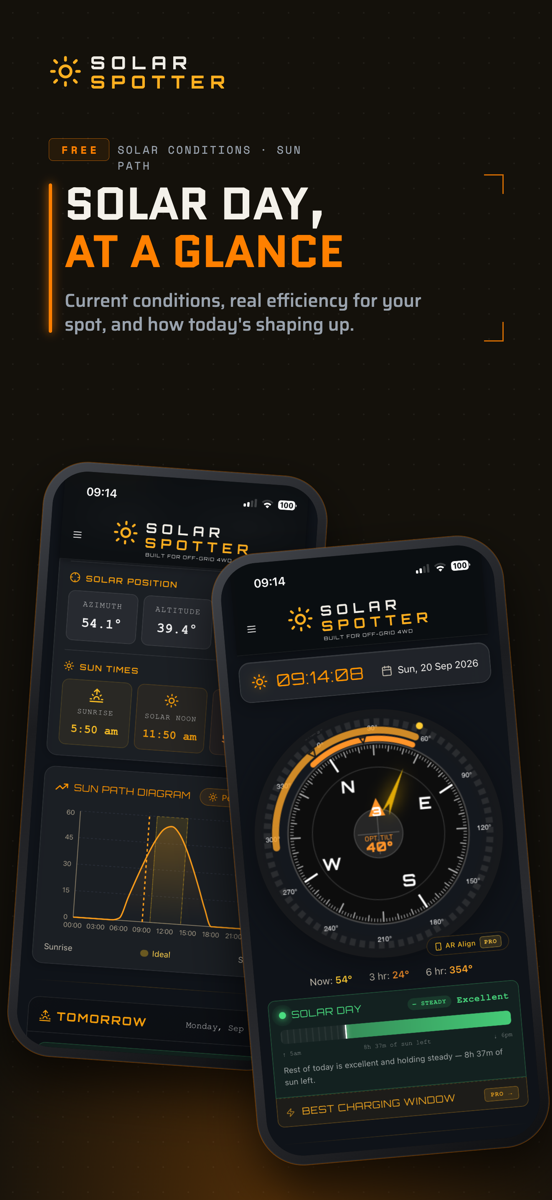
That's what Solar Spotter does. Tell it the window you care about (Pro) and it works out the tilt and direction that pour the most charge in across exactly those hours — from your real position and the sun's actual path there today. Live conditions pick the best window and set the watts.
Three things separate that from a solar calculator:
- It works where you actually camp. Sun position and panel angle are worked out on the phone itself, from your GPS and compass — so it keeps going with no signal at all. Which matters, because the campsites worth driving to are the ones without bars. A web calculator is a paperweight the moment you leave town.
- It's your day, not an average. Most calculators run on monthly or annual averages for a region. This reads the sun's actual arc for your latitude and today's date, against live cloud and conditions for your spot — so the number changes when the sky does.
- It works anywhere on earth. Any latitude, either hemisphere, any season. Boondocking in Utah, overlanding through Namibia, a wet weekend in the Lake District — same maths, no country hardcoded, no assumptions about which way your summer runs.
And your data stays on your phone — no account, no tracking, no data collected. One-off purchase, no subscription.
Free gives you now, +3h and +6h — enough to set up for a morning or an afternoon. Pro adds a rolling best charging window that tracks the day's conditions as they change, plus your own custom window and duration for when you know exactly when you need the power.
Common questions
How do I set up my solar for the most charge?
Three things, in order. Put it where nothing shades it across the hours you're charging. Face it toward the equator — true south in the northern hemisphere, true north in the southern. Tilt it to roughly your latitude, adding about 15° in winter and taking 15° off in summer. That gets you the bulk of it; positioning for the hours you need can add up to about a fifth — most when those hours are early or late, little around midday.
What angle should my solar panel be?
Start at your latitude. At 35° — Los Angeles, Tokyo, Sydney — that's about 35°, steepening to 50° at midwinter and flattening to 20° at midsummer. At 51° (London, Berlin, Vancouver) it's 51°, swinging between 66° and 36°. Being within 15° of ideal costs you almost nothing, so you don't need a protractor — you need to be in the right neighbourhood, and to move it as the day goes on.
Does the best panel angle change with the seasons?
Yes, by a lot. The Earth's 23.5° axial tilt means the angle that faces the noon sun swings about 47° between summer and winter, and the best angle for the whole day swings even more. That's why one bolted-on angle is wrong for most of the year, and why a fixed roof panel gives up more in winter than people expect.
Is it worth moving my panel through the day?
If it's portable, yes — but once is usually enough. The sun moves 15° an hour, so a panel set perfectly at 9am is 45° out by noon; a single reset between morning and afternoon claws back most of that. If you're out for the day, skip the reset and set it once for the hours you'll be away instead. The win is being right for the hours that matter, not adjusting it every hour.
Get the most from your setup
Solar Spotter works out the angle for your exact spot and today's conditions. Free to download — Pro adds the best charging window and shows what your battery will actually do.