Getting the Most From a Solar Blanket
A blanket is the most forgiving solar you can own — it moves, so you can put it exactly where it needs to be. It's also the easiest to waste: flat on the ground, half in the shade, quietly giving away a third to a half of a winter's day, and more the further you are from the equator.
Why a blanket beats a bigger fixed panel
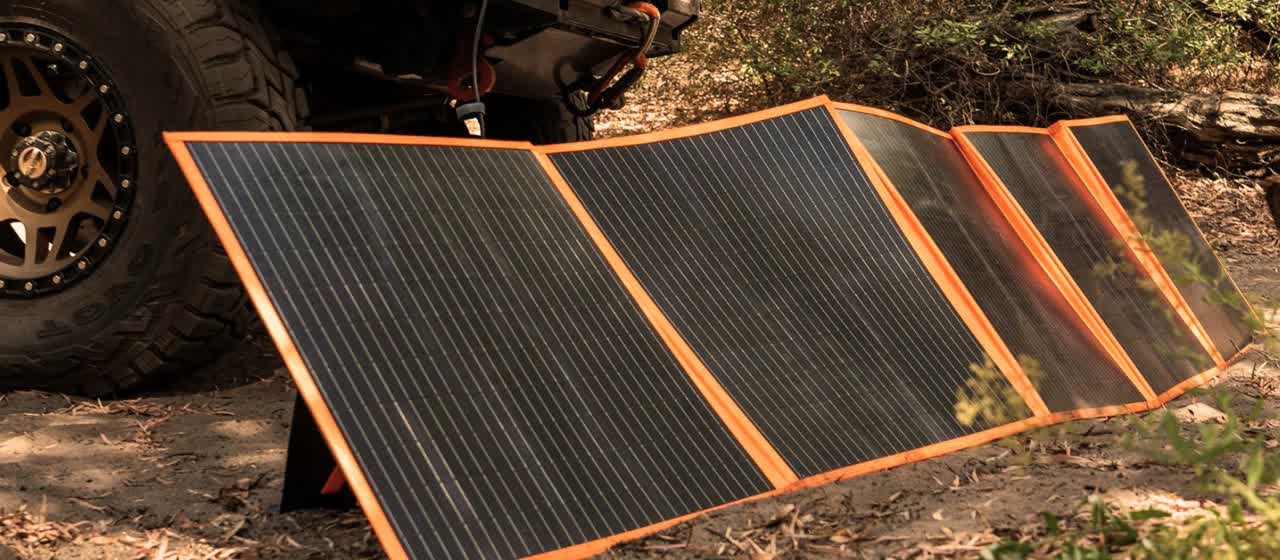
A roof-mounted panel is bolted at whatever angle the roof gives it. A blanket isn't — you can stand it up, position it properly, and move it through the day. That flexibility is worth more than watts: a well-positioned blanket can out-charge a bigger fixed panel that's stuck at the wrong angle, especially in winter.
Which means the blanket is the one bit of solar where setup is entirely in your hands — and where it pays the most.
What lying flat is costing you
If your blanket spends the day flat on the ground, here's what you're leaving behind — measured against the same blanket positioned for a three-hour window early or late in the day, at around 35° latitude (Sydney, LA, Tokyo):
| When you're charging | Morning | Afternoon |
|---|---|---|
| Midsummer | +20% | +43% |
| Spring / autumn | +50% | +90% |
| Midwinter | +157% | +237% |
Every one of those is charge that was available and didn't make it into your battery. In winter a positioned blanket does the work of two-and-a-half flat ones — not because the panel changed, but because low sun hits a flat surface at a glancing angle and a positioned one square-on.
Why flat feels like it works in summer: across a whole day in midsummer, a flat blanket keeps up with a tilted one that never moves — the sun is high for hours, and early and late it sits behind a tilted panel. But nobody charges on a full-day average. You charge in a window, and positioned for a late afternoon the same blanket makes about 40% more.
That's the thing a flat blanket can't do. It does fine when the sun is high around midday, but early and late, and all through winter, it falls right away.
So prop the back edge — a camp chair, a swag, a couple of rocks. Two minutes, no gear. How steep? Roughly your latitude, plus about 15° in winter and minus about 15° in summer. The full setup guide works it out by latitude and explains why the sweet spot keeps moving.
Find the open sky
Shade undoes everything above. The cells in a blanket are wired in chains, and a chain runs at the speed of its weakest cell — so a shadow across one corner can cut far more power than the patch it covers.
Put it where nothing crosses it for your whole charging window, not just where it's clear when you set it down. That shadow will swing round as the day goes, and faster than you'd expect.
Set it twice, not all day
The sun travels 15° an hour, so a blanket set perfectly at nine is 45° out by noon without being touched. Which sounds like it needs constant attention. It doesn't.
One reset between morning and afternoon gets you most of what's on the table. Position it over breakfast, move it once after lunch, and that's the bulk of the gain for about a minute's work all day.
And if you're heading out on the tracks and won't be back till dark, set it once for the timeframe you'll actually be away — a single position chosen for those hours beats a compromise across a day you're not there for.
That's the job a fixed panel can't do at all: not constant fiddling, just being in the right place for the hours that matter.
The real-world fix · Pro
Two AR modes get a blanket spot-on
Rough is easy. Exact needs the sun's actual path for your spot and today's date — arithmetic about a moving target, not something you can eyeball. Two passes: get it close visually, then lock it in with the sensor.
Get it close — visually
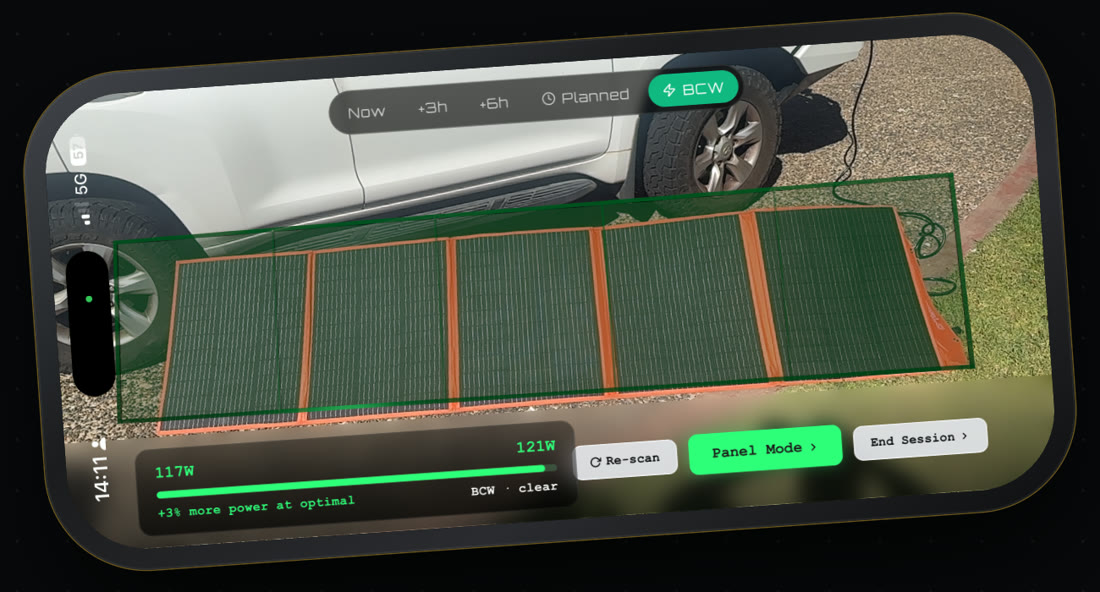
Point your phone at the blanket and the overlay shows where it should sit for your charging window, alongside a bar showing the extra charge you'd gain by matching it. You shift the blanket until the real one lines up with the overlay.
Line it up with the overlay, then tap Re-scan — the power bar shows how close you got.
iOS + Android · ProLock it in — to the degree
Lay the phone flat on the blanket. Panel Mode reads the exact tilt and direction it's sitting at from the phone's own motion sensors, then talks you in with a live Aim Score and audio cues.
Eyes on the gear, not the screen — the tones climb as you close in and change when you're Spot On.
iOS + Android · ProWhat makes that work at a campsite rather than on a desk:
- No signal needed. The sun's path and your panel angle come from the phone's own GPS, compass and motion sensors — not a server. Which is the whole point, because you're setting a blanket up at a campsite, not at a desk.
- It's today's sky, not a seasonal average. A generic angle chart doesn't know it's the 14th of August at your latitude. The watts on the power bar use today's forecast.
- Anywhere on earth. Any latitude, either hemisphere. A blanket propped in Arizona and one propped in the Scottish Highlands want very different angles, and neither is hardcoded.
Free covers now, +3h and +6h — enough to set up for a morning or an afternoon. Pro adds a rolling best charging window that follows the day's conditions, plus your own window and duration. One-off purchase, no subscription, and your data stays on your phone.
Common questions
Do solar blankets need to be angled?
Yes, and by more than most people expect. Against a flat blanket, positioning it for the hours you're charging is worth about 20% on a summer morning, 43% on a summer afternoon, and double or more in winter away from the tropics. The gain is smallest in midsummer and largest in winter — but there is no season where flat comes out ahead over a real charging window.
What angle should a solar blanket be?
Start at roughly your latitude, then add about 15° in winter and take about 15° off in summer. At 35° (Los Angeles, Tokyo, Sydney) that's about 50° in midwinter and 20° in midsummer — June in Sydney, December in LA. The rule works best between about 25° and 45° latitude. You don't need to be precise — within 15° costs you almost nothing — but you do need to be in the right neighbourhood, and to move it as the day goes on.
Can I leave a solar blanket lying flat?
You can, and it'll still charge — but standing it up and positioning it can make anywhere from a little more (a summer midday) to two or three times as much (a winter morning). Flat does fine when the sun is high around midday; it's early and late, and all through winter, that it falls right away. Two minutes propping the back edge buys you more days out between charges.
How often should I move it through the day?
Once is usually enough — a reset between morning and afternoon captures most of what's available. The sun moves 15° an hour, so a blanket left from breakfast to noon ends up about 45° off, but you don't need to chase it hour by hour. If you're leaving camp for the day, set it once for the hours you'll be gone instead. The gain is in being roughly right for the hours that matter, not in constant adjustment.
Get every watt from your blanket
Solar Spotter works out where your blanket should sit for the hours you actually need charge — for your exact spot and today's sun. Free to download.