Why a Little Shade Costs You a Lot
Shade doesn't cost you in proportion to how much it covers. A branch shadow across one corner can take a third of the panel with it, and a thin shadow lying the wrong way can take nearly all of it. Here's what's actually going on inside the panel, and the habit and two rules that keep it from happening.
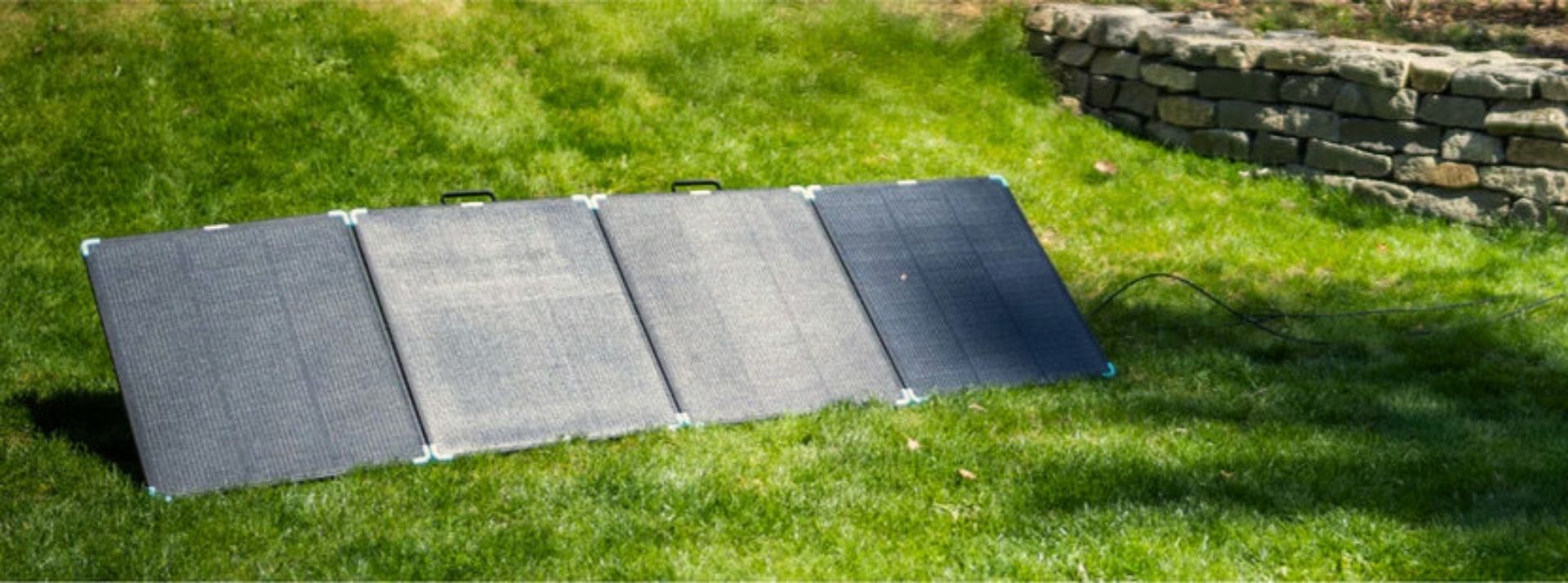
Shade isn't a percentage game
The instinct is that shading a tenth of a panel costs you a tenth of the output. It doesn't work like that. Shade a tenth, and depending on where that tenth falls, you might lose almost nothing — or you might lose a third, or nearly the lot.
That's not the panel failing. It's how every panel is wired, and once you can picture it, the habit and rules that follow are obvious.
What's happening inside the panel
A panel isn't one big light-collecting surface. It's a few dozen individual cells wired in a chain, and the same current has to pass through every one. Think of a kink in a garden hose: a shaded cell is the kink. It can't pass much current, so nothing else in that chain can either. One cell in shadow holds the whole chain back.
Panel makers know this, so they build in an escape route: the cells are split into two or three groups, each with a bypass diode. When a group gets shaded, its diode switches on and the current detours around that entire group. You lose the group, but you keep the rest.
That's the bit that surprises people. The bypass diode is what stops one shaded cell killing the whole panel — and the price of that rescue is that you lose the whole group instead. On a three-group panel, that's about a third of your output, whether the shadow covered one cell or twenty.
Roughly what it costs you
| What's in shadow | Roughly what you keep |
|---|---|
| Nothing — panel fully clear | 100% |
| A patch inside one group, any size | ~65% |
| Patches in two of three groups | ~33% |
| A thin shadow clipping all three groups | ~5–15% |
| Whole panel shaded, clear sky above | ~10–20% |
Two things worth reading off that table. First, the jump from "a patch" to "a thin line" is enormous, and the thin line is the one people don't see coming — a tent pole, an awning rail, a roof rack bar, an antenna. Second, the bottom two rows are close together, which is the real punchline: a pole shadow lying the wrong way across your panel costs you about as much as parking the whole thing in the shade.
Those percentages assume a three-group panel, which covers a lot of rigid panels and many folding ones. Some have two groups, a few have more — so treat the numbers as the shape of the problem rather than a spec sheet. The shape is what matters, and the shape doesn't change.
A folding panel or blanket is the same story, one size up: each folding section usually behaves as its own group. Shade one section of a four-section blanket and you've generally lost that section — which is why a blanket draped over gear with one panel in a shadow can read so much lower than you'd expect.
The shade that gets you isn't there yet
This one has nothing to do with wiring.
You set up at nine in the morning. The panel is in clean sun, the tree is well off to one side, everything looks right. By half eleven the shadow is across the bottom of the panel and you've lost most of your day's charge without ever seeing it happen — because you were at the beach, or asleep, or just not staring at your panel.
The sun moves about 15° across the sky every hour. Shadows swing with it all day, and they get longer as the sun drops through the afternoon. A shadow that's a comfortable two metres clear at midday can be over your panel by mid-afternoon. In winter the sun stays lower all day — the further you are from the equator, the lower — so shadows run longer and reach much further than they look like they will.
So "is it in the shade?" is the wrong question. The right one is "will it still be clear for the whole time I'm charging?" — the next three hours, or longer.
One habit, two rules
The habit comes first, because it stops the problem instead of working around it. Look up before you unfold. Most shade problems are decided in the ten seconds before setup, by noticing the branch, the awning arm or the vehicle that's currently behind you and will be in front of the sun in a couple of hours.
The two rules are for the site that still isn't perfect once you've looked up.
- Pick open ground, not a sunny hole. A gap in the trees is sunny only while the sun is in the gap — and it won't be for long. Open ground stays clear as the sun moves, which is the whole point. It's easier to move the vehicle than to find extra cable, so work with the lead you have: back up, pull forward, swing the nose around until the panel can go down in a clear spot. If you are buying cable anyway, a few extra metres of decent gauge costs a couple of percent, and one clipped group costs thirty-plus.
- If shade is unavoidable, keep it at one end. A shadow confined to one end of the panel takes a group. The same shadow lying across the panel's width takes the lot. Turning the panel so an unavoidable shadow runs the long way, rather than banding across it, can be the difference between losing a third and losing nearly everything.
Where the app earns its keep here
Solar Spotter doesn't look at your campsite. It has no idea where your trees are, or your awning, or the van parked beside you — and it doesn't need to, because you can see all of that yourself.
What it does know, precisely, is where the sun will be. Direction and height above the horizon, for your exact spot and today's date, now and through the rest of the day.
That's the missing half of the shade problem. The obstacles you can see for yourself; where the sun will have swung to in three hours, and in six, you can only guess at by eye. The app puts a bearing on it — stand where the panel will go, look along that bearing, and anything standing in the line is a shadow on its way, worked out before you've unfolded anything.
On the main screen, the Solar Position card gives the sun's bearing (azimuth) and height (altitude) right now, the compass shows where it travels over the next few hours, and the Sun Path Diagram draws the whole day's arc so you can see how high it gets and when.
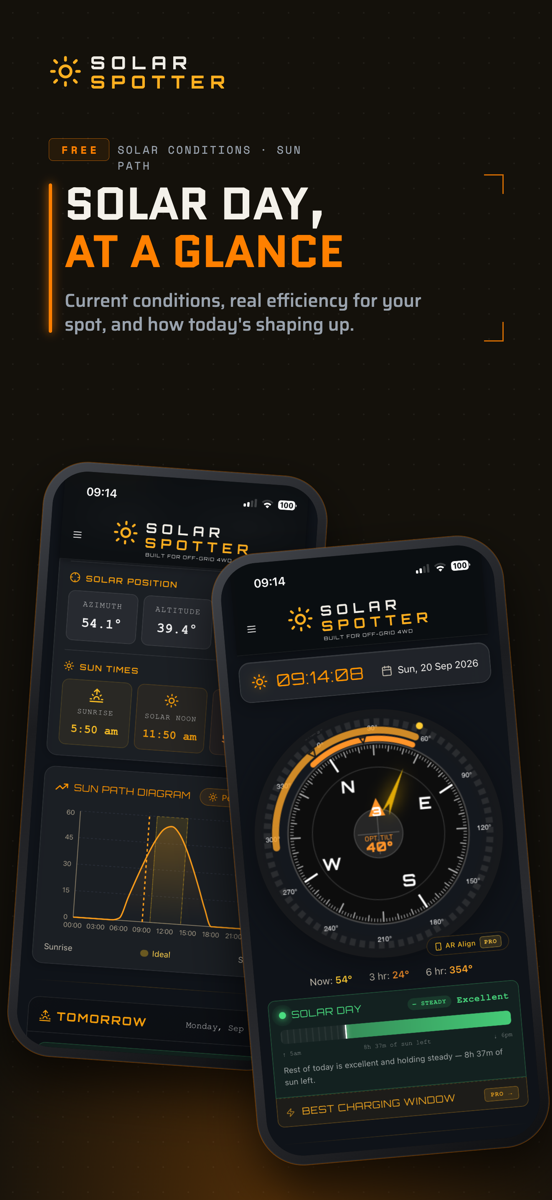
That's a different job from a solar calculator, and it's worth being specific about why:
- It works out the sun's track for your exact location and the season you're in. Not a table, not a monthly average — your latitude, today's date. The same campsite gives you a completely different shadow map in summer than in winter. That's derived from where you actually are, every time.
- It shows you the hours ahead, not just this instant. Free gives you the sun's bearing now plus two bands on the compass tracing the arc of sky it sweeps over the next three hours and the next six (cut off at sunset), with a bearing for each under the dial. Stand at your panel, face along those bands, and anything sitting in that arc is a shadow that's coming for you. Pro adds the Best Charging Window — the window of today the forecast says is worth charging in, rolling forward as the day goes — and Planned Charge in the menu, where you set your own time window or a duration from now. The compass then draws that span as its own band, so you can check the sky across the timeframe you actually care about rather than the moment you happen to be standing there.
- It keeps working when your signal doesn't. Some of the best campsites have no signal, or barely any. Sun position is astronomy, worked out on the phone with no reception at all, so you can still choose your spot and keep the panel clear of shade all day.
- Your location is yours. The sun maths runs on the phone. The only time your location leaves it is the weather request, so the forecast is for where you are — and nothing is stored. No account, no tracking, no data collection of any kind. It's a one-off purchase, not a subscription.
One reading not to misread: the Shade Risk tile on the main screen is about the sky, not your campsite. It's worked out from cloud cover and the chance of rain, and it tells you when the sun is sitting low (Low sun angle). A Low there means a clear sky, not a clear spot — the trees, the awning and the vehicle are still yours to check.
Whether you're camping, touring in a van, overlanding, boondocking or running a boat — any latitude, either hemisphere, any season — the sun's track is the one thing you can know for certain before you commit to a spot.
Common questions
How much does shade affect a solar panel?
Far more than the shaded area suggests. Panels are split into two or three groups of cells, and shading any part of a group generally takes that whole group out — so a shadow covering a few percent of the panel can cost you a third of the output. A thin shadow that clips all three groups, like a pole or an awning rail lying across the panel, can cost you nearly everything.
Will a solar panel work in the shade?
A little. In full shade under a clear sky the panel still sees light scattered from the blue sky above it, which is worth roughly 10–20% of what it would make in direct sun. That's enough to trickle, not enough to run a fridge. Dappled shade under a tree is wildly variable and generally worse than it looks, because the moving pattern keeps clipping different groups.
Why does a small shadow cause such a big drop?
Because the cells are wired in a chain and a chain carries the same current throughout, so one shaded cell throttles all the cells wired with it. Panels contain bypass diodes to stop that spreading across the whole panel — but the diode works by cutting out the entire affected group. That's why the loss arrives in big steps rather than gradually: you lose a third, not a fiftieth.
Does it matter which way a shadow falls across the panel?
Yes, and it's the single most useful thing to know. The cell groups usually run the length of the panel, so a shadow lying along that length may only clip one group and cost you about a third. The same shadow banded across the panel's width clips every group at once and can cost you nearly the lot. If you can't avoid a shadow, keeping it confined to one end is much cheaper than letting it stripe across.
Is it better to move the panel or use a longer cable?
Move the vehicle first. Your panel came with a set length of lead, and there's no ducking to the shops from a remote bush camp — so the practical fix is parking so that lead reaches clear ground. A longer lead is still a good trade if you carry one: a few extra metres of decent gauge costs a couple of percent in voltage drop, while one shaded cell group costs thirty percent or more.
How do I know if shade will reach my panel later in the day?
Work it from where the sun is going rather than where the shadow is now. The sun moves about 15° an hour across the sky, climbing all morning and dropping all afternoon, so shadows swing all day and lengthen after midday. A gap that's clear at nine can be gone by eleven. Solar Spotter shows the sun's direction and height for your spot through the rest of the day, so you can read the shadow's path before you set up. In winter, away from the tropics, shadows reach much further than they look.
Know where the sun's going before you set up
Solar Spotter shows the sun's direction and height for your exact spot — now and through the hours ahead — so you can see which way a shadow will travel before you unfold anything. Free to download.