Why Your 200W Panel Never Makes 200W
Watch the display on a clear, still day with everything set up properly and a framed 200 W panel will sit somewhere around 160 W. A 200 W blanket, in the same sun, closer to 130. Nothing is broken and nobody lied to you — the number on the sticker was measured under conditions your campsite will almost never reproduce. Here's where the difference goes, and what a genuinely good day should look like.
The sticker is a lab result, not a promise
Every panel is rated under one fixed set of conditions, the same for every manufacturer so the numbers can be compared. Those conditions are: full midday sun straight onto the panel, and a cell temperature of 25 °C.
That last one is the killer. 25 °C is a mild spring morning — not the temperature of a dark panel sitting in direct sun. How far above the air a panel runs depends on how hard the light is falling on it: in strong overhead sun it's 25–30 °C above air temperature, so on a 30 °C day the cells sit near 55–60 °C and have done since mid-morning.
Under a weak sun the rise is a fraction of that. At a clear midwinter noon in a temperate spot the panel might be only 12–15 °C above the air, and with the air near freezing the cells land close to the 25 °C the sticker was measured at. The heat penalty is a summer and tropics problem, not a year-round one — which matters whichever hemisphere you're in, because your summer is somebody else's winter.
Where the watts actually go
| What takes it | Typical cost on a warm clear day |
|---|---|
| Cell heat — cells at 55–65 °C instead of 25 °C | −10–20% |
| Blanket or bonded laminate rather than a framed panel | −15% |
| Dust, pollen, salt, bird mess | −2–5% |
| Cable and connections | −1–3% |
| Controller losses — MPPT | −3–5% |
| Controller losses — PWM on a 12 V battery | −20–25% |
| Not square to the sun — worst under a low sun | −0–65% |
Stack the ordinary ones — heat, a bit of dust, decent cable, an MPPT controller, panel positioned properly — and a framed 200 W panel lands around 160 W at its best moment of the day. That is a good result. That is the panel working correctly.
The last row is the only one that can swallow the panel whole, and it is the one you control. Out by 30° costs about 13%; out by 60°, half. A panel left flat under a sun 20° off the horizon — a midwinter morning anywhere well away from the tropics — is down about two thirds on the same panel stood square to it.
The PWM row is the one worth acting on. A cheap PWM controller drags your panel's voltage down to whatever the battery is sitting at. A typical 12 V panel wants to work near 18 V; the battery is at about 13. That gap is thrown away as heat, and it is roughly a fifth to a quarter of your panel — every single day, in every condition. An MPPT controller converts that extra voltage into extra current instead. It is the one component swap that reliably buys back double-digit percentages.
The same 200 W, two different panels
A framed panel is glass in an aluminium frame about as thick as your finger, with air moving behind it. A blanket is a few millimetres of laminate sewn onto canvas, with nothing behind it to carry the heat away. Same number on the label, different result: reckon on a blanket giving 15–20% less than a framed panel of the same rating — the wider end on a hot day, because the thinner build also loses more per degree of heat.
Don't test it by bending it — a blanket's segments are rigid by design and most manuals say not to flex them. The tell is the edge. Glass in a metal frame, finger-thick, is a rigid panel. A few millimetres of laminate on fabric is a blanket, however stiff each section feels.
It's also the one spec you can get wrong on paper. Solar Spotter's Pro panel setup rolls two questions into one row — what the panel is made of, and whether it stays put — so you pick from Rigid · fixed, Flexible · fixed, Rigid · portable and Blanket · portable. Get the first half wrong and every figure the app gives you afterwards is out by 15–20%.
The heat one runs backwards in the cold
Panels are the rare bit of camping gear that works better when it's freezing. The loss above runs at roughly 0.3–0.5% for every degree the cells sit above 25 °C — nearer the top of that range for a blanket — and it runs the other way too. A clear, cold day with the air near 0 °C puts the cells close to 25 °C even in full sun, so the heat penalty simply isn't there.
Add snow or pale ground bouncing light back up at the panel and it is entirely possible to meet or beat the rated figure on a cold clear day. If you're solar-ing somewhere genuinely cold — the Alps, a Canadian or Scandinavian winter, the South Island, a frosty inland run — the panel is not your problem. The short day and the low sun are, and those are a positioning question rather than a hardware one.
One thing to expect from the app in the cold. Solar Spotter caps the cold bonus on purpose, so its figure won't climb meaningfully above your panel's sticker number however cold it gets. A real panel can edge past; the app would rather sit slightly under than promise you a day you don't get. If you're reading a little less in the app than your controller shows on a frosty morning, that's the app being careful, not your panel failing.
Peak watts is the wrong number to judge on anyway
Peak watts is a single instant. What fills your battery is watt-hours — how much you're making multiplied by how long you hold it. A panel that reads 180 W for a few minutes and 60 W the rest of the day loses easily to one sitting at 120 W all afternoon.
Which makes the highest number on your display a poor test of the setup. Most of a day's energy lands in the middle block of the day, when the sun is highest — so that's the timeframe worth setting up for, or whichever window you actually need the charge in. The setup guide covers how to position for a span of hours rather than a moment.
When it is a fault
Everything above is normal. These are the readings that aren't:
- Roughly a third or two thirds missing on a clear day. Losses that arrive in clean fractions are a shading signature, not a heat one — see why a little shade costs you a lot.
- Under 20% in bright conditions with nothing shading it. Check connections, the controller's own settings, and whether the battery is simply already full and the charger has backed off.
- Nothing at all, in good sun. A blown fuse, a controller that hasn't detected the panel, or a reversed connection. Not a performance question.
- It was fine last season and is well down now. Soiling that never got washed off, a cracked cell, or a connector that has corroded. Clean it first — it takes a minute and it is often the whole answer.
- Consistently well under, with nothing else wrong. The sticker itself is a candidate. A no-name panel sold on its peak-watt number is sometimes rated optimistically, and everything downstream inherits that — including any app you type the rating into.
"Fine last season, well down now" is the hard one to judge by eye, because a run of dull weather looks exactly like it. Pro can answer it from your own history instead of a guess, if you run a battery it can read over Bluetooth.
It compares what your rig actually harvested against what the sky was offering on each day, so a fortnight of cloud isn't counted as a fault. Once it has about thirty recorded days to work with and your recent ones have fallen roughly a quarter behind the run before them, it says so — once, and then it holds its tongue for a fortnight. Its first suggestion is a wipe over the panels, because dust and road grime top the list.
Knowing what "good" looks like today
All of the above collapses into one practical problem: to know whether 140 W is good, you have to know what today could give. That number moves with the season, your latitude, the temperature and the sky — so a fixed expectation is wrong most of the year.
Solar Spotter works that out from where you actually are. Pro's Estimated Output card takes your own panels and today's real conditions and prints the watts each one should be making right now, a Combined figure if you run more than one, a recharge rate per hour against your battery, and Remaining charge today — the energy still to come before sunset. Entering your panels is part of Pro; free gets a worked sample of the same card, showing a 200 W blanket at 125 W.
Read it as a figure at the panel, not at the battery. The app works out what the sunlight, the temperature, your panel's construction and its angle allow, and stops there. It doesn't know which controller you have, how long your cable run is, or how dusty the glass is. So an MPPT controller's own display should land reasonably close to it — and a PWM one will read well below. That gap is the controller row, not a fault.
It also means the app is only as honest as the figures you gave it: the rating comes off your sticker, because nothing else can, and the construction comes from which row you picked in setup. Both are worth a second look before you accuse the panel of anything.
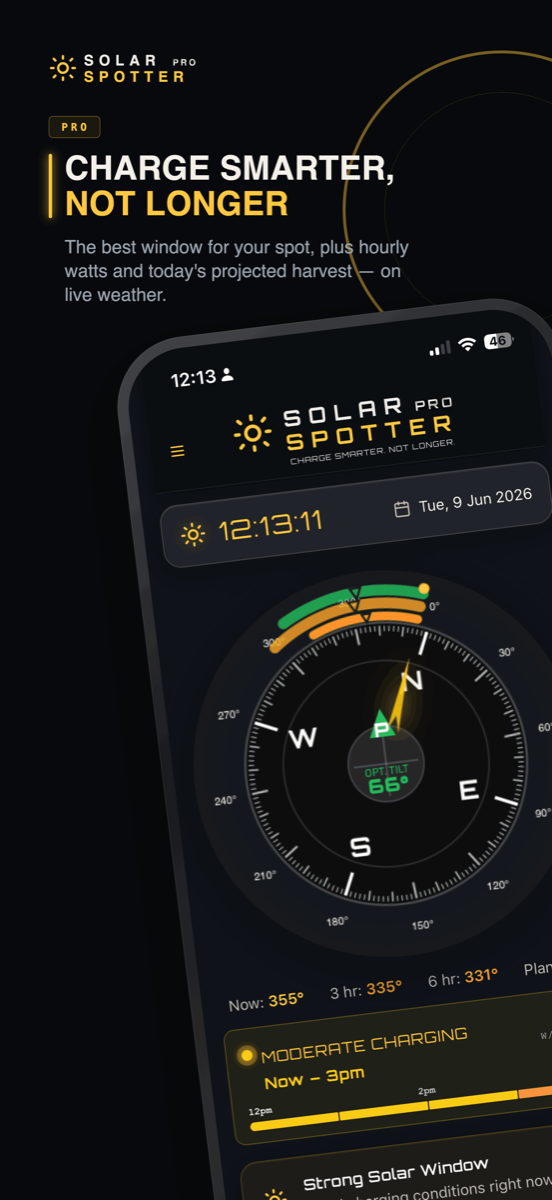
- It calculates for your exact spot and the season you're in. Not a national average and not a monthly table — your latitude and today's date. It works anywhere on the globe, so the answer is right in a Spanish July and a Patagonian January alike.
- The angle is the loss you can undo on the spot. Free shows Opt. Tilt on the Solar Position card: the angle that puts the panel square to the sun at this moment. It works against the largest row in the table above, and on a low sun it is worth tens of watts within a minute of moving the panel.
- It tells you when the day is poor rather than flattering it. Free shows Sky Rating — how much light the cloud and rain are letting through — beside the W/m² actually arriving, and underneath it names what is costing you: heavy cloud, rain, low sun, or more than one at once. A low number that reads as honestly low is what stops you pulling connections apart on a day that was never going to give you more.
- It shows the hours ahead, not just now. Free draws the arc of sky the sun will sweep between now and three hours out, and again to six, each with its bearing under the dial, and cuts the arc off at sunset. Pro adds Best Charging Window, which rolls forward through the day on live weather, and Planned Charge in the menu, where you pick a duration or your own window and get one tilt for the whole period.
- The sun maths works with no signal. Sun position, panel angles and the tilt all run on the phone. The sky readings need a connection, so when the phone hasn't got one the app switches to offline mode by itself and keeps the last forecast it saved on screen with the time it was fetched. Bush Bash Mode in the menu does the same by choice, and it's free too.
Camping, vanlife, overlanding, boondocking or on the water — any latitude, either hemisphere, any season. There's no account, no tracking and no analytics: the sun maths runs on your phone, and the only time your location leaves it is the weather request, so the forecast is for where you are — and nothing is stored. One-off purchase, no subscription.
Common questions
Why is my solar panel not producing its rated watts?
Because the rating is measured at a cell temperature of 25 °C in full laboratory sun. In strong sun a panel runs 25–30 °C above the air temperature, and output drops roughly 0.3–0.5% for every degree above 25 °C. Add a little dust and normal cable and controller losses and a framed 200 W panel making around 160 W on a warm clear day is working exactly as designed. A 200 W blanket in the same sun is nearer 130 W, and that is also correct.
What output should I actually expect from a 200W panel?
From a framed panel, roughly 150–170 W at its best moment on a warm, clear day, positioned properly and on an MPPT controller. From a 200 W blanket, nearer 125–140 W — thin laminate on fabric makes less than glass in a frame. On a cold clear day either climbs well past its warm-weather figure, because the heat penalty disappears. With a PWM controller, knock another 20–25% off whatever you were expecting.
Do solar panels work better in cold weather?
Yes, noticeably. Panels lose output as they heat up, so cold air means the cells stay near their rated temperature and the usual heat penalty of 10–20% disappears. A crisp, clear winter's day with snow or pale ground reflecting light back up can push a panel to or past its rated figure. What limits you in winter isn't the panel — it's the short day and the low sun angle, and both are a positioning problem rather than a hardware one.
Is MPPT really worth it over PWM?
On a 12 V system with a standard panel, yes — it is usually the biggest single improvement available. A PWM controller pulls the panel down to battery voltage, throwing away the gap between the panel's working voltage of around 18 V and the battery's 13 V or so. That is roughly 20–25% of your panel, permanently. MPPT converts that surplus voltage into extra charging current instead.
Does dust really make a difference?
A few percent in ordinary conditions, and considerably more if it has built up over a season or you're somewhere dusty, salty or under trees. It is worth a wipe because it takes a minute — but if you're missing a third of your output, dust is not the culprit. Losses in clean fractions point at shade.
See what your panel should actually make today
Free rates today's sky for your exact spot and gives you the tilt to set right now, so you can see when a low number is just the weather. Pro works out the realistic output for your own panels, so you know whether it's the weather, the setup, or a genuine fault.