Why Your Solar Slows Down on a Cloudy Day
Cloud doesn't break anything — it cuts the light, and your output follows it down. What matters is how thick. Thin overcast still passes plenty; heavy storm cloud leaves you a trickle. Here's roughly what to expect from each, and how to claw back what you can.
It's the light, not your gear
Nothing's broken. Cloud cuts the light reaching the panel, so output drops with the sky and climbs straight back when it clears. Your gear is fine — it's just got less to work with.
How much do you still get?
Roughly, as a share of what the same panel makes under clear sky:
| What it looks like | Roughly what you get |
|---|---|
| Bright, thin overcast — soft shadows | 40–60% |
| Solid grey cloud — no shadows at all | 15–25% |
| Dark storm cloud, heavy rain | Under 10% |
Those are wide ranges, and they deserve to be. Cloud thickness varies enormously, and two grey days that look identical from your camp chair can differ by a factor of three. There's no single number here, and anyone who gives you one is guessing. What the ranges are good for is a sanity check: if it's bright overcast and you're seeing 10%, something else is going on — shade on the panel, an angle that's well off, or a battery that's already near full, where the controller deliberately backs the charge off.
The one upside of a grey day: under cloud, light arrives from all over the sky rather than straight from the sun. So the penalty for a less-than-perfect angle softens right off. On a properly overcast day, a flat panel and a well-positioned one are much closer together than they'd be in clear sun — and under thick, even grey, flat can edge ahead, because it faces the brightest part of an overcast sky, which is straight up.
Make the most of a dull day
- Keep it in the open. Under cloud the light arrives from the whole sky, so what counts is how much open sky the panel can see. An awning, a tree canopy or the side of the vehicle each hide a slice of it. A clear spot beats a clever angle.
- Ease off the big loads. The charge you do make goes further. Fridge aside, most things can wait for sun.
- Play the breaks. Under solid grey, flat is fine. On a day of sun and cloud, keep the panel facing where the sun is, because each break arrives from there at full strength. You may even see output jump briefly past a clear-day figure as the sun comes out beside a bright white cloud — light bouncing off the cloud onto the panel. That's real, and it passes in minutes.
Know what the day can actually give
This is where guessing hurts most. A low number on a cloudy day looks like a fault when it's simply the truth, and people spend an afternoon checking connections that were never the problem.
Solar Spotter turns the weather for your spot into a few plain readings on the main screen. All of these are free:
- Sky Rating is the app's version of the table above: how much of the sun's light the cloud and rain are letting through, as a percentage. Next to it, W/m² is how much light is actually reaching the ground, which also depends on how high the sun is — so a grey noon and a clear hour near sunset can land in the same place. A clear noon near the equator runs 900–1,000 W/m²; further from it, and earlier or later in the day, a clear sky gives less. The app grades that figure: 500 and up is Excellent, 300–500 Good, 150–300 Moderate, under 150 Poor.
- The card underneath says why. On a dull day it reads Moderate Solar Window or Low Solar Window and names the cause — heavy cloud, rain, low sun, or more than one of them. If it blames the sun and not the sky, the weather was never the problem.
- Shade Risk sits on the Solar Conditions card beside Sky Rating, and it reads the sky, not your site: it climbs to Medium or High with heavy cloud or a decent chance of rain. It can't see the tree over your camp — the shade guide covers that.
- Opt. Tilt, on the Solar Position card, keeps reading square to the sun whatever the sky is doing — it's the angle you want the second a break opens. Under solid grey it simply stops mattering much.
- Solar Day grades the rest of today and says which way it's heading: improving, steady or fading. On a grey morning that's the line to read — "clearing" means the afternoon is worth waiting for.
- Tomorrow gives tomorrow's cloud, its grade and roughly how many hours of good sun it should hold, so you can decide whether to ration today or spend it.
With Pro, Estimated Output adds the watts your own panels should be making under this sky and the Remaining charge today still to come. Hold that against what your controller or battery is showing: agreement means the weather, a big gap means the setup. Best Charging Window takes the place of Solar Day and still finds the best hours left in a grey day, and the 3-Day Outlook replaces the Tomorrow card.
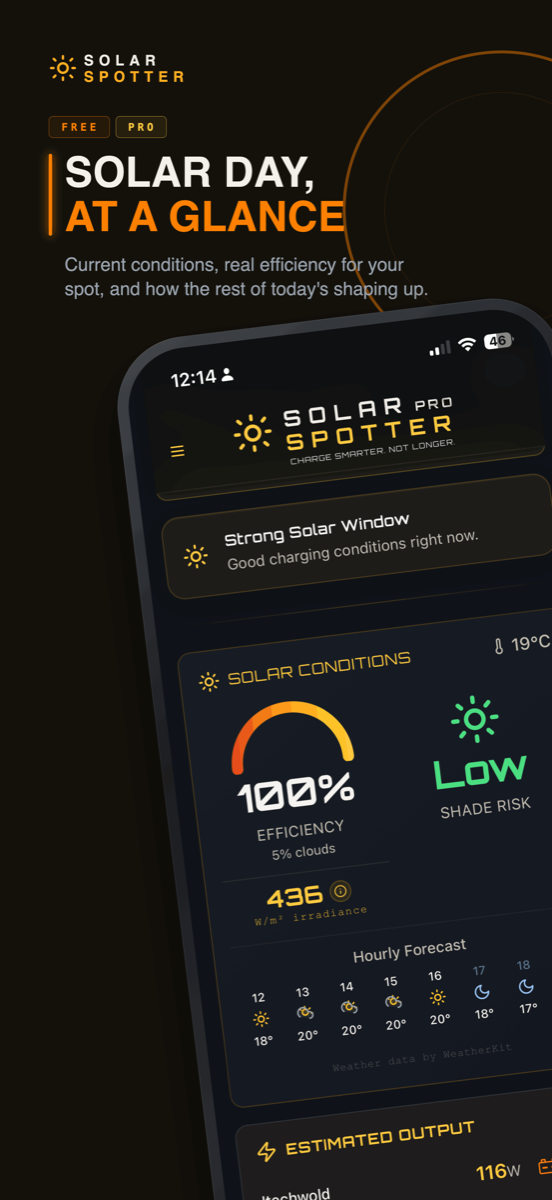
This is the guide where the difference from a solar calculator matters most, because a calculator can't see the sky:
- It reads today, not a monthly average. Every sizing chart and angle table assumes a typical day. A cloudy Tuesday isn't a typical day, and the whole question here is what this sky can give you. The weather refreshes every 15 minutes for your spot, so the readings follow the day as it turns.
- It tells you it's a bad day rather than hiding it. A calculator hands you a typical day's figure, which on a grey day is the optimistic one. A low number that reads as honestly low is what stops you spending an afternoon checking connections that were never the problem.
- It's a forecast reading, not a meter on your panel. The Sky Rating comes from the cloud cover and rain forecast for your spot, and cloud cover counts how much of the sky is covered, not how thick it is. So under thin high cloud your panel can beat the reading, and under a heavy dark sky it can fall short of it. A single passing cloud also moves faster than any forecast.
- The sun maths works with no signal. Sun position and panel angles run on the phone. The sky readings need a connection, so when the phone hasn't got one the app switches to offline mode by itself and keeps the last forecast it saved on screen, with the time it was fetched. Bush Bash Mode in the menu does the same by choice. A grey day at a remote site is exactly when you least want a tool that needs reception.
Any latitude, either hemisphere, any season. There's no account, no tracking and no analytics: the sun maths runs on your phone, and the only time your location leaves it is the weather request, so the forecast is for where you are — and nothing is stored. One-off purchase, no subscription.
Common questions
Do solar panels work on cloudy days?
Yes, just less. Panels run on light, not heat, so cloud cuts output without stopping it. Bright thin overcast still gives you roughly 40–60% of a clear day; solid grey cloud drops you to about 15–25%; heavy storm cloud can take you under 10%. The panel is working the whole time — it just has less to work with.
Why is my solar not charging in cloudy weather?
Almost always it's the cloud cutting the light rather than a fault, and output picks back up when the sky does. Worth ruling out three things first though: anything shading the panel, a battery that's already near full (the controller backs the charge off on purpose), and — while the sun is still showing through — a panel lying flat when the sun is low. If it's bright overcast and you're getting almost nothing, the cloud probably isn't the culprit.
How much solar do you get on an overcast day?
Anywhere from under 10% to about 60% of a clear day, depending entirely on how thick the cloud is. Bright overcast where you can still see soft shadows sits at the top of that range; a dark storm sky sits at the bottom. It's a wide spread because cloud is genuinely that variable — which is why a live reading for your actual sky beats any rule of thumb.
Will my solar panels charge in the rain?
A little. Rain means heavy cloud, so there's not much light — expect the bottom of the range, under 10%. The rain itself won't hurt a sealed panel, and it'll wash the dust off, which is worth a percent or two once the sun's back.
Does panel angle matter on cloudy days?
Less than on a clear day. Under cloud the light is scattered across the whole sky rather than arriving from one direction, so a panel that's off-angle loses much less than it would in direct sun — under thick, even grey, flat is as good as any angle. Getting it out into open sky matters more than getting it positioned right. Once the sky clears, angle goes back to being the biggest lever — the setup guide covers it.
See what today can really give
Free, it grades the sky for your spot, names what's costing you the light, and tells you whether the rest of today is clearing or closing in. Pro adds what your own panels should be making under that sky, so you can hold it against what your gear is showing.