How Long Does Solar Take to Charge a Battery?
There's a real answer to this, and it's arithmetic rather than opinion. The catch is that two of the three numbers you need are usually guessed at:
- how much your panel actually delivers
- how much usable sun your location gets
Get those right and the rest is a single division.
The short version
Three numbers, one sum:
Energy you need ÷ energy your panel makes in a day = days of charging
Everything below is just getting those two numbers honest, because that's where the usual answers fall over.
1. How much energy you actually need
Batteries are sold in amp-hours; sunlight arrives in watts. Convert once and stay in watt-hours and everything gets easier:
Watt-hours = amp-hours × battery voltage. A 100 Ah 12 V battery holds roughly 1,280 Wh, using 12.8 V for a lithium pack.
But you almost never charge from empty. Lithium is usually run down to about 20% and lead-acid shouldn't go below 50%, so the realistic job is smaller than the battery's headline number:
| Battery | Full capacity | Typical refill from a normal low |
|---|---|---|
| 100 Ah lithium (down to 20%) | 1,280 Wh | ~1,020 Wh |
| 100 Ah AGM / lead-acid (down to 50%) | 1,200 Wh | ~600 Wh |
2. How much your panel makes in a day
Here's where the guesses go wrong. A 200 W panel does not make 200 W for eight hours.
It doesn't make its rated watts. The rating is a laboratory figure at 25 °C. Between cell heat, dust, cable, controller losses and the panel not being perfectly square to the sun, about 70% of the rated figure reaches the battery across a real day. That's the number the sizing calculator uses, and here's where the other 30% goes.
And it doesn't get full sun all day. Sunlight is weak at dawn, strongest near midday, weak again at dusk. Rather than track that curve, the whole day gets flattened into peak sun hours — the number of hours of full-strength sun that would deliver the same total energy. A fourteen-hour summer day might be worth six peak sun hours; a short overcast winter one might be worth one.
Full-strength sun is about 1,000 watts per square metre. The app shows it as irradiance (W/m²), so 500 W/m² for two hours is about one peak sun hour.
So:
Daily watt-hours = panel watts × peak sun hours × 0.7
Worked through
A 200 W panel, a 100 Ah lithium battery down to 20%, and a decent spring day worth 5 peak sun hours:
- Panel gives: 200 × 5 × 0.7 = 700 Wh for the day
- Battery needs: 1,020 Wh
- 1,020 ÷ 700 = about a day and a half
Same battery, same panel, a poor winter day worth 1.5 peak sun hours:
- Panel gives: 200 × 1.5 × 0.7 = 210 Wh
- 1,020 ÷ 210 = the better part of five days
Same gear, and the answer moved by a factor of three. Which is the real lesson here: anyone who answers this question without asking where you are and what time of year it is has given you a number for somewhere else.
The bit the sum leaves out
That arithmetic assumes nothing is drawing from the battery while it charges — and something always is. If your fridge is pulling 40 W through the middle of the day, that comes off the top before anything reaches storage. In practice, plenty of setups spend the whole day nearly breaking even and do their real charging on the sunny hours when the fridge happens to be resting.
So the honest version of the question isn't "how long to charge" but "will I be ahead by sunset." Working out what a night costs you is the other half.
Peak sun hours is the number you can't guess
Everything above is easy except one figure, and it's the one that swings the answer most — three times between the two days above, and far more in a far-north or far-south winter. Peak sun hours depends on your latitude, the date, the weather and how your panel is set up — it isn't a property of your gear, so no amount of reading the panel's spec sheet will tell you.
Solar Spotter does that part for you. With Pro, it takes your spot and today's sky and shows how much charge your panel should still make before sunset, rather than what a chart for somewhere else says it might.
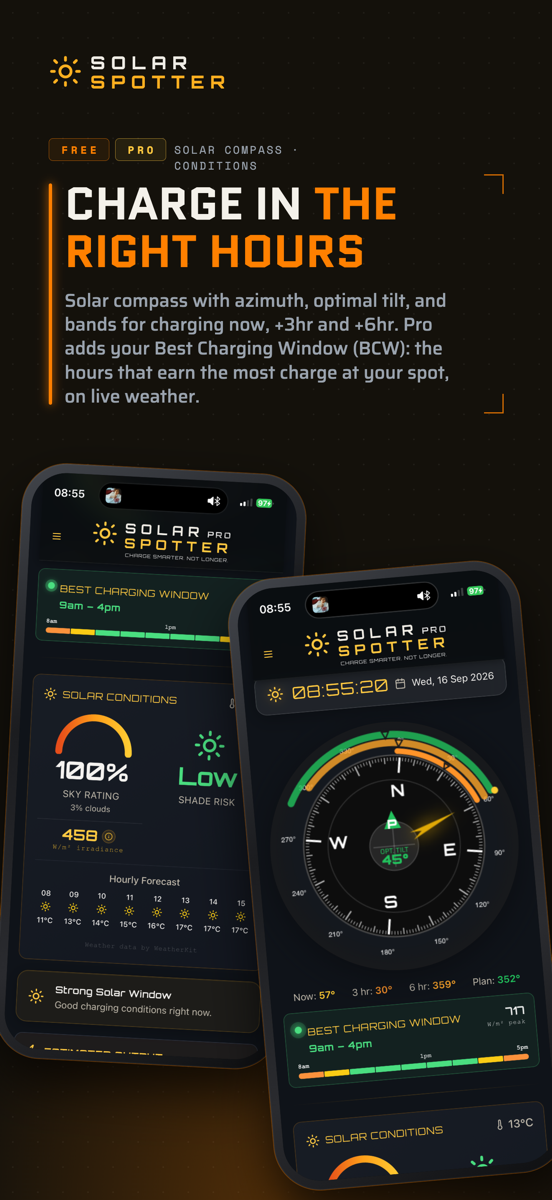
- It calculates for your exact location and the season you're in — any latitude, either hemisphere.
- It reads today rather than an average. A monthly average is the one number guaranteed to be wrong on the day you're actually standing there.
- It shows the hours ahead so you can be set up for the good ones. Free gives you now and roughly three and six hours out; Pro adds the rolling best charging window and a window and duration you choose.
- It's honest when the answer is bad, which is the whole point — a flattering estimate is how people end up short after dark.
- Works with no signal. Once it has a forecast, it keeps showing the last one it saved and tells you how old it is — whether it's a weekend camp or a month of overlanding. No account and no tracking: the only thing that leaves your phone is the weather request for your spot. One-off purchase, no subscription.
Common questions
How long does it take to charge a 100Ah battery with a 200W solar panel?
On a good day worth about five peak sun hours, a 200 W panel delivers roughly 700 Wh, and refilling a 100 Ah lithium battery from a normal 20% low needs about 1,020 Wh — so a day and a half. On a poor winter day worth 1.5 peak sun hours it's closer to five days. The gear is identical in both cases; the location and season are what changed.
What is a peak sun hour?
It's a way of flattening a whole day's curve into one number: the hours of full-strength sunlight that would deliver the same total energy as the actual day did. Sun is weak at dawn, strong at midday and weak at dusk, so a fourteen-hour summer day might only be worth six peak sun hours. It depends on your latitude, the date, the weather and the angle of your panel — not on the panel itself.
Why doesn't my 200W panel deliver 200W?
Because the rating is measured in a lab at a cell temperature of 25 °C, and a panel in real sun runs far hotter than that. Add dust, cable losses, controller losses and the panel not sitting perfectly square to the sun, and about 70% of the rated figure reaches the battery over a real day. On a cold clear day it can do considerably better, because the heat penalty disappears.
Can solar charge a battery on a cloudy day?
Yes, just far more slowly. Bright thin overcast gives you roughly 40–60% of a clear day, solid grey cloud about 15–25%, and heavy storm cloud under 10%. Run those through the same sum and a cloudy spell can turn a day and a half of charging into a week, which is why several dull days in a row is the situation that actually catches people out.
Does the battery charge faster when it's nearly empty?
Not really. With solar, your panel sets the pace, not the battery. A lithium battery takes everything the panel gives until it's nearly full, then slows for the last few percent. AGM and lead-acid batteries slow from about 80%, so their last fifth can take most of an afternoon. That's normal, not a fault.
Get the answer for your own setup
Solar Spotter reads your location, the season and today's sky. Free to download — Pro shows what your own panels will deliver and how full your battery will be by tonight.